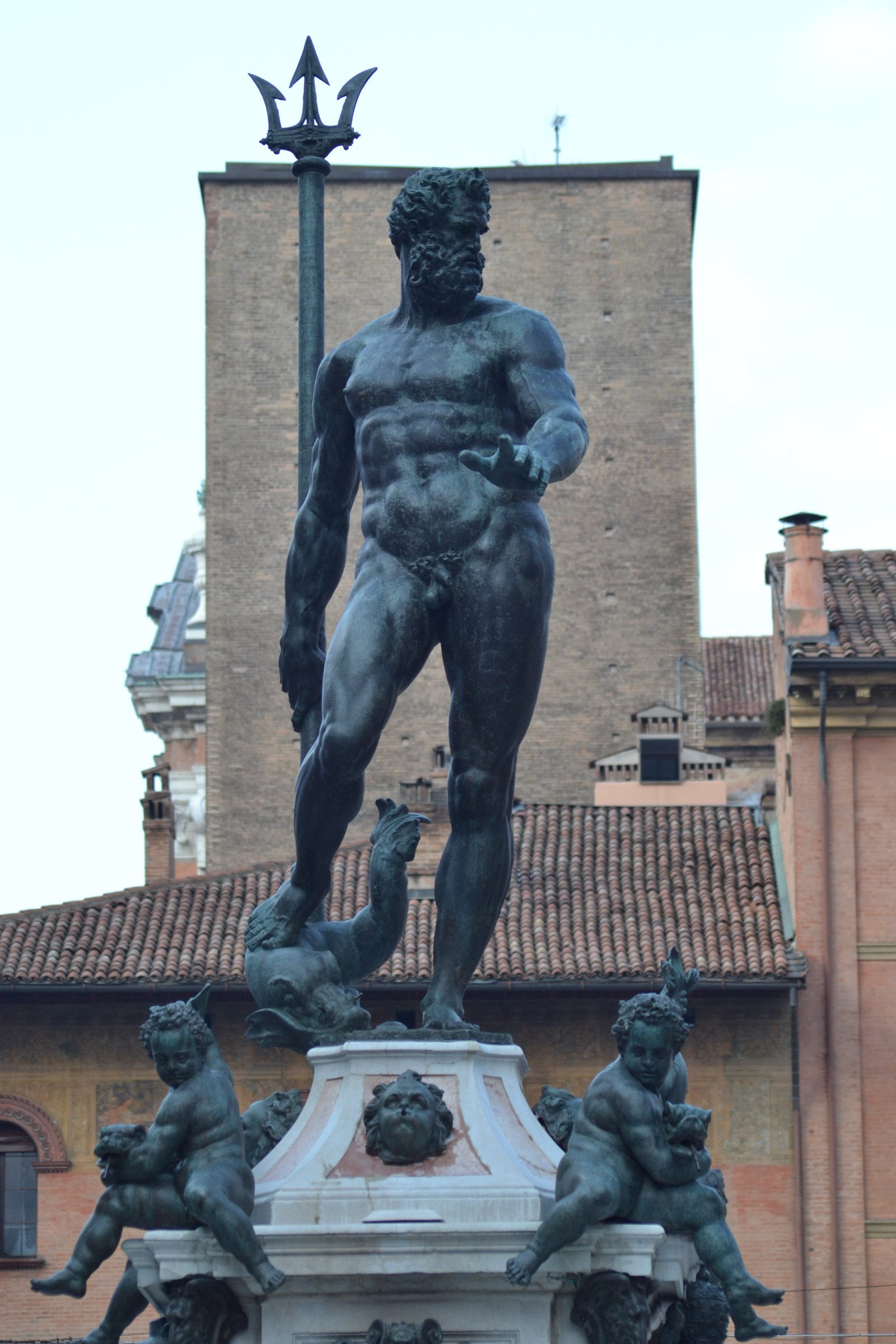
Picture a garden. A bronze Poseidon stands in the middle of it, trident raised, wearing absolutely nothing. Nobody minds. Garden centers sell him by the pallet, and he looks rather good next to the hydrangeas.
Now picture the neighbor, stepping out beside him in the same pose, wearing the same nothing. Within the hour there is a police car at the curb and a charge of public indecency.
Same body. Same yard. The only difference is that one of them is made of metal.
They take the man away. The god stays where he is, and so do his relatives all over the world. Giambologna's Neptune has stood naked in the main square of Bologna since the 1560s. Michelangelo's David has stood in Florence for five centuries, with a full-size copy still outside in the Piazza della Signoria, where tourists line up for selfies with him every day. And if you want the full collection, the Vatican keeps some of the finest naked gods ever carved, the Apollo Belvedere and the Laocoon among them, a few still wearing the fig leaves added in the 1500s.
The Odyssey and the naked god of the sea
If Poseidon feels familiar this year, thank Christopher Nolan. The Odyssey has taken nearly $1.8 billion at the box office, and the oldest road trip in literature is suddenly the biggest story in the world. Poseidon is its villain, the god of the sea who hounds Odysseus across the waves for ten years, and Giambologna's Neptune is the very same god under his Roman name. Every god in Homer's story has a naked statue somewhere. The greatest of them came out of the sea itself: the bronze god of Artemision, pulled from the waters off Cape Artemision in the 1920s, now stands fully naked in the National Archaeological Museum in Athens, arm drawn back to throw. Scholars still argue whether he is Zeus hurling a thunderbolt or Poseidon hurling his trident. Either way, nobody has ever asked him to put something on. Homer also gave us, nearly three thousand years ago, the first fig leaf. When Odysseus washes ashore after the shipwreck, stripped of everything, he breaks a leafy branch from a thicket to cover himself before he faces another soul. The god goes naked. The man reaches for a branch. The double standard is as old as the story itself.
Naked gods around the world
And it is not just Europe. Humanity has been carving naked men for as long as it has been carving anything. In ancient Egypt, Min, the god of fertility, was cut into temple walls with nothing hidden at all. In southern India, the Gommateshwara statue at Shravanabelagola, carved around 983 AD, rises fifty-seven feet from a single block of granite, completely nude, and pilgrims still pour milk and saffron over him in a great ceremony roughly every twelve years. On a hillside in Dorset, England, the Cerne Abbas Giant, a naked man with a club, one hundred and eighty feet tall, has been cut into the chalk since sometime between 700 and 1100 AD. You can see him from the road.
France, England and the fig leaf
Even the nations with a reputation for blushing could not stop building them. Louis XIV filled the gardens of Versailles with naked river gods. In 1822 the women of England raised the money for a colossal bronze Achilles in Hyde Park, cast from captured French cannon in honor of the Duke of Wellington, and often called London's first public nude. The unveiling caused such a stir that the statue was given a fig leaf. Commissioned by women, covered by committee.
The long career of the fig leaf
The fig leaf has a long and slightly ridiculous career. After the Council of Trent, the painter Daniele da Volterra was hired to brush drapery over the nudes of Michelangelo's Last Judgment, and history has called him Il Braghettone, the breeches-maker, ever since. When Queen Victoria gave the South Kensington Museum, today the V&A, a plaster cast of David, the museum had a two-foot plaster fig leaf made for it, kept on hand and hung on a pair of hooks whenever the Queen came to visit. You can still see that fig leaf in London today, displayed on the back of the plinth. The David, of course, kept his original.
Neptune, banned by an algorithm
Which brings us to 2017, and the moment the oldest double standard in art went digital. An art historian in Bologna, Elisa Barbari, posted a photograph of the city's Neptune to promote her page about Bologna's history. Facebook removed it as sexually explicit, explaining that nudity is not allowed, quote, "even if the use is for artistic or educational reasons." A four-hundred-and-fifty-year-old god of the sea, banned by an algorithm. Facebook later apologized and called it an error. Neptune did not comment.
Naked versus nude
So what is the difference between a naked god and a naked man?
Nothing in the body. Everything in the frame. The god is an idea, not a person, so nobody is exposed. Bronze cannot blush; flesh can. Five hundred years turn a scandal into heritage. And a pedestal, a temple or a museum wall tells you how to look before you have even looked. A photograph on a phone arrives with no frame at all.
The art historian Kenneth Clark put it perfectly in 1956. To be naked, he wrote, is to be deprived of our clothes, exposed. The nude is something else: the body clothed in art. The god on the pedestal is a nude. The neighbor in the yard is naked. The god is an idea wearing a body. The man is just a body.
That is the whole reason a magazine like this one exists. Our job is to put the frame back around real people, so that a photograph is read the way we read the statue. With attention. With respect. As art.
Nº 43 Statuesque: the living statue
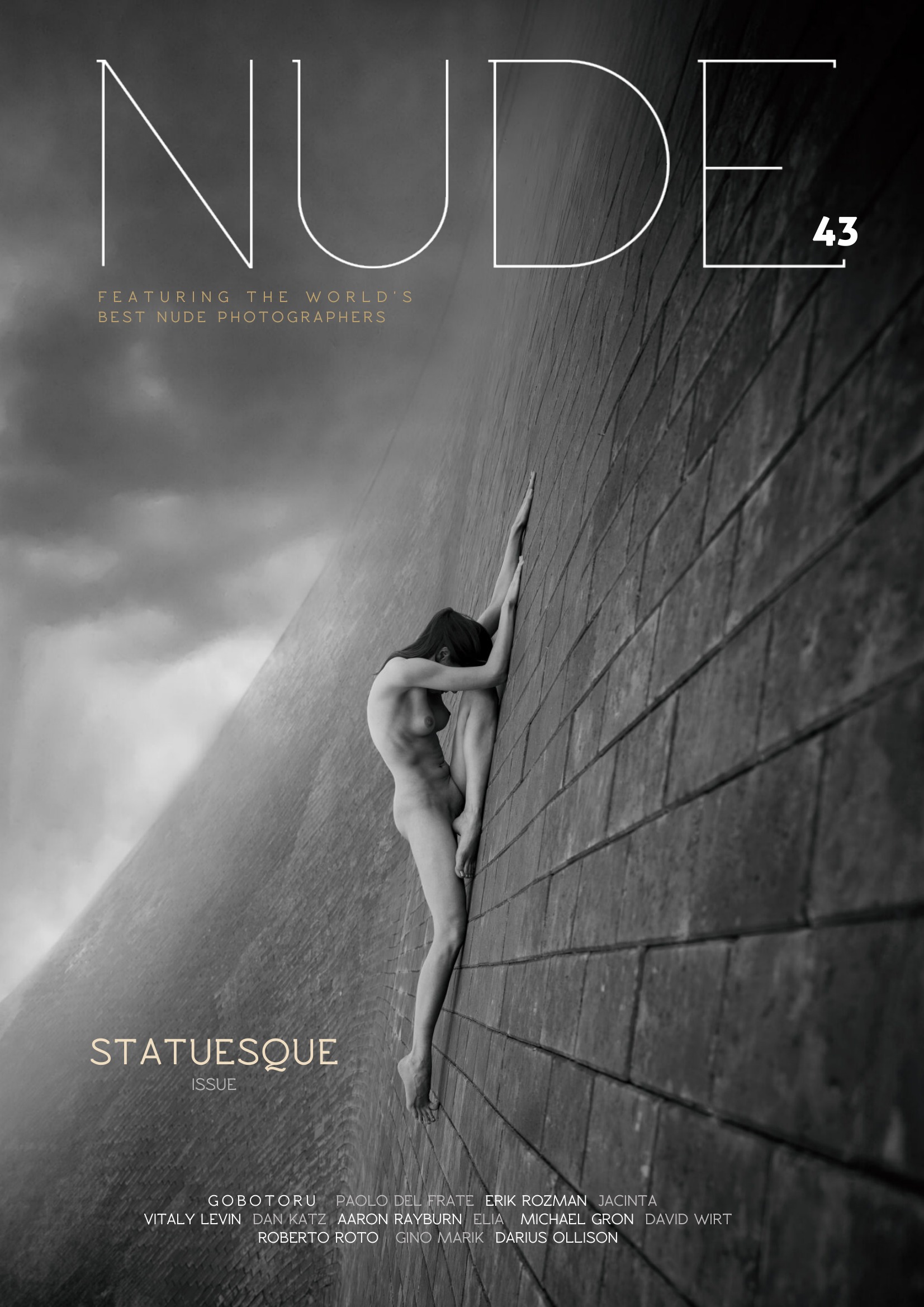
We once gave a whole issue to that idea. In April 2024 we published Nº 43, Statuesque. The statue, as we wrote in its opening pages, was once the model of artistic form. So we asked thirteen photographers to find that form again in living bodies. On the cover, Viktoria, photographed by Gobotoru, holds herself against a towering stone wall, so still she could have been carved into it. Look twice and you remember she is breathing. That is the whole trick of the fine art nude: a real person, given the stillness and the dignity we usually reserve for marble. If you want to see what a statue looks like when it is alive, start there.
Read Nº 43 Statuesque: lenudemagazine.com/issue_page.html?n=43
And the gods, of course, were men. Outstanding male models have always been welcome in our pages, and they always will be.
Masters, then and now
The sculptors who carved those gods were masters of their craft. This December, our Masters issue returns to celebrate the same thing in photography: craft, and the photographers who have mastered it.
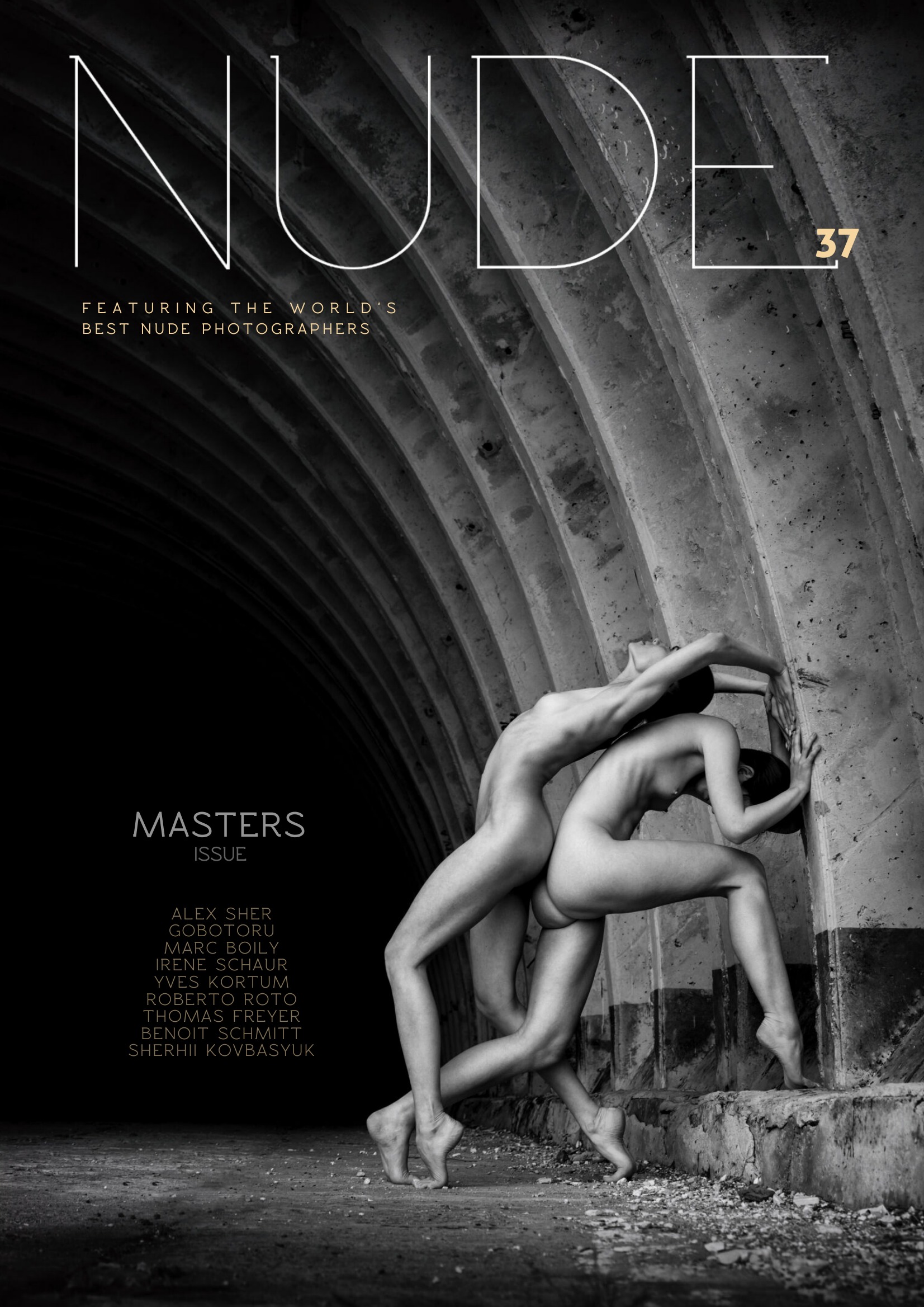
Our last Masters edition, Nº 37, is still in the catalogue: lenudemagazine.com/issue_page.html?n=37
So here is our question, and we would genuinely like your answer. Where did we learn that the fine art nude should not be seen in public, when naked gods have stood in our gardens, squares and temples for thousands of years? Tell us in the comments.
Next time: if the gods were men, where did all the men go?
Esha · The NUDE Team
Also on Substack: lenudemagazine.substack.com